In shortThe black sand beach on the Road to Hana sits inside Waianapanapa State Park, open daily 7:00 a.m. to 6:00 p.m. Entry and parking both need reservations, released 30 days ahead one date at a time at midnight Hawaii Standard Time and sold in four time slots. Nothing is sold same day, the gate stops admitting at 5:30 p.m., and you leave when your slot ends.
7:00 a.m.–6:00 p.m.Park opening hours
30 daysReservation release window
4 slotsSold per day
5:30 p.m.Last entry at the gate
What the black sand beach on the Road to Hana actually holds
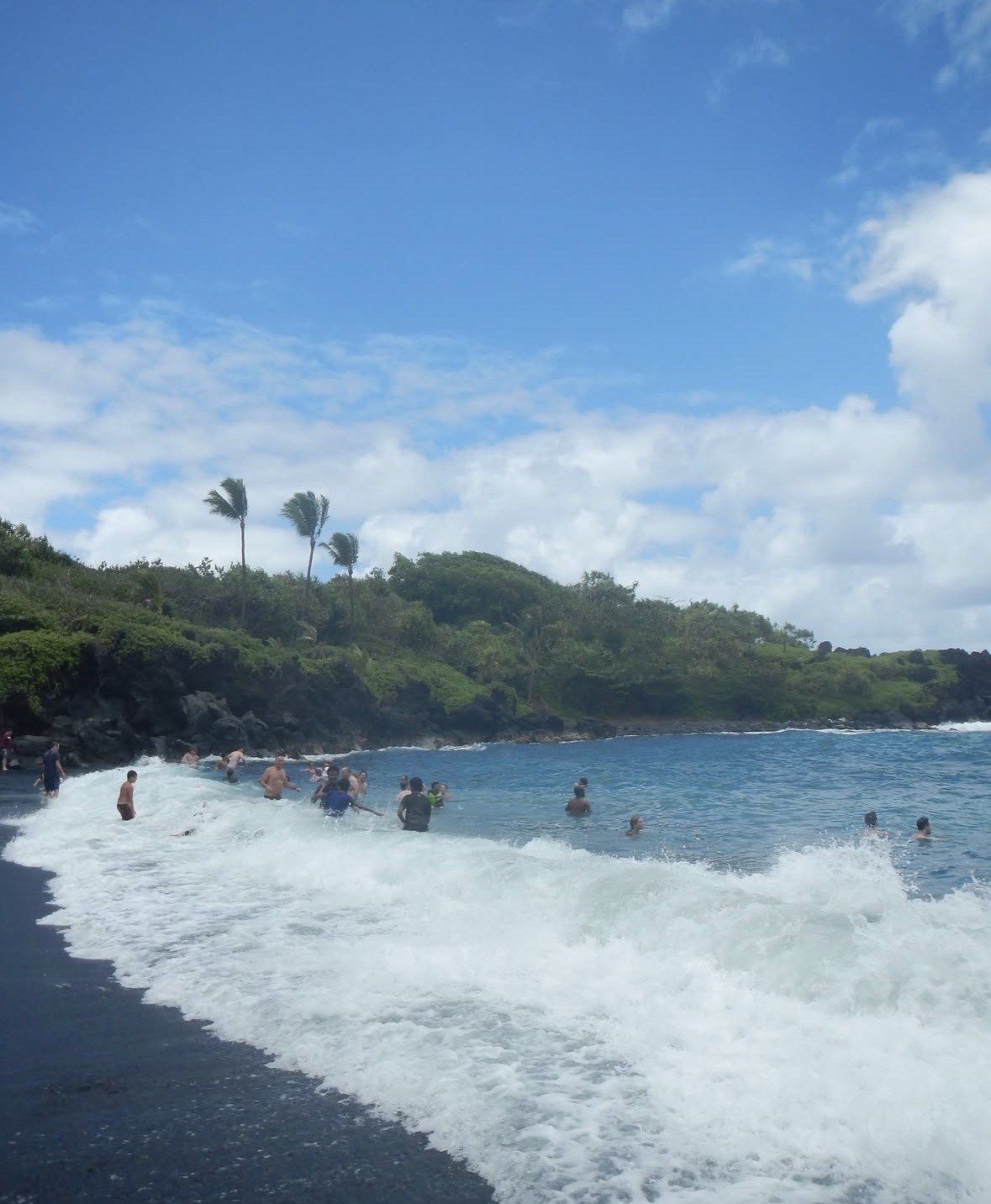
The beach is small. Hawaii State Parks describes it that way, and the cove is the smallest part of what the park covers: a native hala forest behind the shore, sea stacks standing off the water, blow holes in the lava shelf, a natural stone arch, a seabird colony and a heiau within the park boundary.
An old coastal route runs out of the park as well. State Parks names it Ke Ala Loa O Maui/Piilani, an ancient Hawaiian coastal trail heading toward Hana town, and calls it hardy family hiking. No official distance is published for it, so treat it as a walk you cut short rather than one you finish inside a timed slot.
The state's current park notices show the Maui parks reopened apart from Polipoli, with water service at Waianapanapa restored. That page changes, so look at it the morning you travel rather than the week before.
- A small black sand beach
- A native hala forest
- Sea stacks off the shoreline
- Blow holes in the lava rock
- A natural stone arch
- A seabird colony
- A heiau inside the park
- Ke Ala Loa O Maui/Piilani, the ancient coastal trail toward Hana
Small group day with the fees settled
This 8 to 10 hour tour carries 6 to 8 passengers with hotel pickup, breakfast, a hot plate lunch and all fees and taxes covered, so the four-slot reservation system is not your problem.
★ 4.6/5 · 1,092 reviews
Waianapanapa State Park entry and parking rules
Two separate reservations stand between a visitor and the sand: one for entry, one for the vehicle. The official reservation FAQ is blunt about the consequence, saying anyone without them is turned away, and the only exception it names is a Hawaii resident with a valid state ID.
Timing is the part that catches people out. The park sells the day in four slots, and bookings open 30 days ahead, one date at a time, at midnight Hawaii Standard Time. Staying from opening until sunset means holding all four. The latest slot carries a 6:00 p.m. label, but the gate stops letting people in at 5:30 p.m., and when a slot ends you are expected to be out of the park.
No slot is sold on the day of the visit, so arriving hopeful is not a plan. The state notice board has also carried a posting about this park that reads inconsistently, so confirm the day's status with the state parks office if your date is close.
| Rule | What the official park pages state |
|---|
| Opening hours | Daily, 7:00 a.m. to 6:00 p.m. |
|---|
| Reservations | Required for both entry and parking; visitors without them are turned away, except Hawaii residents with a valid state ID |
|---|
| Release window | 30 days in advance, one day at a time, at midnight Hawaii Standard Time |
|---|
| Time slots | Four per day; opening until sunset requires all four |
|---|
| Same-day booking | Not available |
|---|
| Last entry | Latest slot is 6:00 p.m., but entry must happen by 5:30 p.m., and visitors leave when the slot ends |
|---|
| Non-resident entry | $5.00 per person; children 3 and under not charged; Hawaii residents with licence or ID not charged |
|---|
| Non-commercial parking | $10 per vehicle, charged per time slot |
|---|
| Permitted commercial vehicles | $25 for 1 to 7 passengers, $50 for 8 to 25, $90 for 26 or more |
|---|
Why nobody on a tour books a slot
Permitted commercial vehicles sit in their own parking category at this park: $25 for 1 to 7 passengers, $50 for 8 to 25 and $90 for 26 or more, against $10 for a non-commercial vehicle. That charge belongs to the operator holding the permit, which is why a tour passenger never sees the four-slot calendar, never watches a midnight release and never has a parking confirmation to produce at the gate.
Hawaii's tourism authority takes the same line for the road as a whole, encouraging visitors to do it as a permitted guided tour. On a page about one timed state park that advice has a very concrete meaning: the access problem has already been solved by whoever is driving.
Camping, cabins and the construction period
Overnight stays run on a different system from the day slots. Camping is permit only, at $30 per campsite per night for non-residents and $20 for residents. The state cabins are $100 per cabin per night for non-residents and $70 for residents, and they have to be booked at least 7 days before check-in.
Camper-van camping is off the table for a long stretch: from 1 July 2026 through March 2027 those reservations are unavailable while the park's new comfort station is built. Weather removes nights too. In 2026 the state closed camping at the park from 9/24 to 9/28 as a storm precaution.
Surf, lava rock and closures to plan around
The features that make the park worth the drive also describe the hazard. Blow holes, a stone arch and sea stacks mean an exposed lava shelf with open ocean working against it, and wet lava rock gives very little grip. Hawaii's official beach safety service monitors Maui beaches on the north, west and Kihei shores and lists nothing on the Hana side, and it states plainly that lifeguards are not always on duty or available.
Footwear matters more than most visitors expect. The National Park Service recommends sturdy hiking shoes on East Maui trails, which can be steep with loose cinders or rock, and advises planning for rain at any time of year. The same agency has measured East Maui streams rising as fast as 4 feet in 10 minutes, and Hawaii's code of conduct tells visitors to stay out of water during heavy rain or flash-flood conditions.
Closures are part of the record here rather than a freak event, as the late-September 2026 camping shutdown shows. A day with a fixed slot and a 5:30 p.m. cut-off leaves no room to wait out a storm warning and come back later.
Which day trip gets you to the park
If the cove is the reason you are driving east, take a full-route day with the fees settled in advance. The 8 to 10 hour small-group tour on this site runs with 6 to 8 passengers, from $282 and rated 4.6 ★ (1092 reviews), with hotel pickup and drop-off, a continental breakfast, a hot made-to-order Hawaiian BBQ plate lunch, Maui potato chips, all-day water and all fees and taxes covered. Bags have to fit under a seat, vegetarian plates need 48 hours' notice, and wheelchairs, scooters, walkers and crutches cannot be carried.
A cheaper, shorter full day works from Kahului: 7 to 8 hours, from $200, rated 4.7 ★ (159 reviews), with an air-conditioned vehicle, breakfast, a 6-inch sub or a gluten-free vegan wrap, chips and water. Island guests meet at 7:20 a.m. in Kahului and cruise passengers at 8:30 a.m. by the Burger King parking lot, and there is no minimum party size, so one person can travel.
The 4 to 5 hour private trip from Island Fresh Cafe in Paia, from $279 and rated 4.9 ★ (127 reviews), is a different proposition. It works the first cluster of mile markers and gets you back with an afternoon spare, so Hana and the timed park at the far end are not part of that day. Choose it if you only have a short window or you're travelling with small children. The black sand beach is out of reach on this one.
Questions people ask
Are there lava tubes at Waianapanapa State Park?
The official state parks description of the park lists a native hala forest, a heiau, sea stacks, blow holes, a natural stone arch, a seabird colony and the small black sand beach. Lava tubes are not on that list. The cave attraction people often search for under that name is a separate site in the Hana area with its own admission and hours, and we could not verify its current operating status, so do not build a day around it.
Can you swim at the black sand beach?
Conditions decide it on the day, and the shoreline is lava rock with blow holes, an arch and sea stacks rather than a sheltered bay. Hawaii's official beach safety service monitors beaches on Maui's north, west and Kihei shores and lists none on the Hana side, and it warns that lifeguards are not always on duty or available. Keep off wet rock and watch the surf before anyone goes in.
How far is the park from Kahului?
Hawaii's tourism authority puts Hana 52 miles from Kahului and the drive at two to four hours one way, because of 620 curves and 59 bridges on the highway. The park sits at Hana, so the outbound leg is the same order of time, then the same again home. That is why the tours that reach it run 7 hours and more.
Is the heiau at the park the big one people read about?
No. The heiau named as the largest ancient structure in Polynesia is Piilanihale Heiau, which stands inside Kahanu Garden at 650 Ulaino Road, open 9 a.m. to 3 p.m. Monday to Friday with everyone out by 3:30 p.m. and admission at $18 for adults. Waianapanapa's own feature list includes a heiau, and it is a separate site within the state park.
Can you walk from the park into Hana town?
Ke Ala Loa O Maui/Piilani, the ancient coastal trail at the park, runs toward Hana and State Parks calls it hardy family hiking. No official length or walking time is published for it. With a time slot that ends on the clock and a park that closes at 6:00 p.m., plan a stretch of it and turn back rather than treating it as a route into town.
Read also